Why There Is No Nothing Phone 4 — And Why That Actually Makes Sense
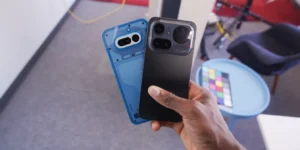
Nothing’s CEO Carl Pei made it official: there is no Nothing Phone 4 this year. The company openly stated they would not release a new flagship simply for the sake of releasing one. On the surface, this reads as a thoughtful product philosophy — only ship something when it genuinely moves the needle. Beneath that framing, though, there is a harder business reality.
As a relatively small player in the global smartphone supply chain, Nothing places smaller component orders than Samsung and Xiaoxia of the world. This means higher per-unit costs on the same hardware. Combine that with the industry-wide spike in DRAM prices, and suddenly building a competitive flagship — think Snapdragon 8 Elite Gen 5, 16GB RAM, silicon-carbon battery — becomes both financially brutal and commercially risky. The Nothing Phone 3 at $800 proved that its fanbase has a clear price-sensitivity threshold. So Nothing pivoted smartly: lean into the mid-range and upper mid-range where they can genuinely compete, and compete hard.
The result is the Nothing Phone 4A at €349 (Europe and select markets) and the Nothing Phone 4A Pro at $499 in the US. And the honest assessment? This is probably where Nothing belongs right now — and these are arguably their best phones yet.
Full Specifications: Nothing Phone 4A vs Nothing Phone 4A Pro
| Specification | Nothing Phone 4A | Nothing Phone 4A Pro |
|---|---|---|
| Chipset | Snapdragon 7s Gen 4 | Snapdragon 7 Gen 4 |
| Display | OLED, 120Hz LTPS | OLED, 144Hz LTPS (120Hz real-world) |
| Peak brightness | 4,500 nits | 5,000 nits |
| Build | Plastic + glass (Gorilla Glass 7i) | Unibody aluminum + glass |
| Cameras | 50MP main, 8MP ultrawide, 3.5x tele | 50MP main, 8MP ultrawide, 3.5x tele |
| Max zoom | 70x digital | 140x digital |
| Battery | 5,000+ mAh | 5,000+ mAh |
| Storage (base) | 128GB UFS 3.1 | 128GB UFS 3.1 |
| Wireless charging | No | No |
| IP rating | IP64 | IP65 |
| Glyph interface | 7 LED bar (right side) | Full pixel-dot matrix display |
| OS | Nothing OS 4.1 (Android 16) | |
| Price | €349 | $499 (US) |
Design and Build Quality: Nothing’s Best-Looking Phones to Date
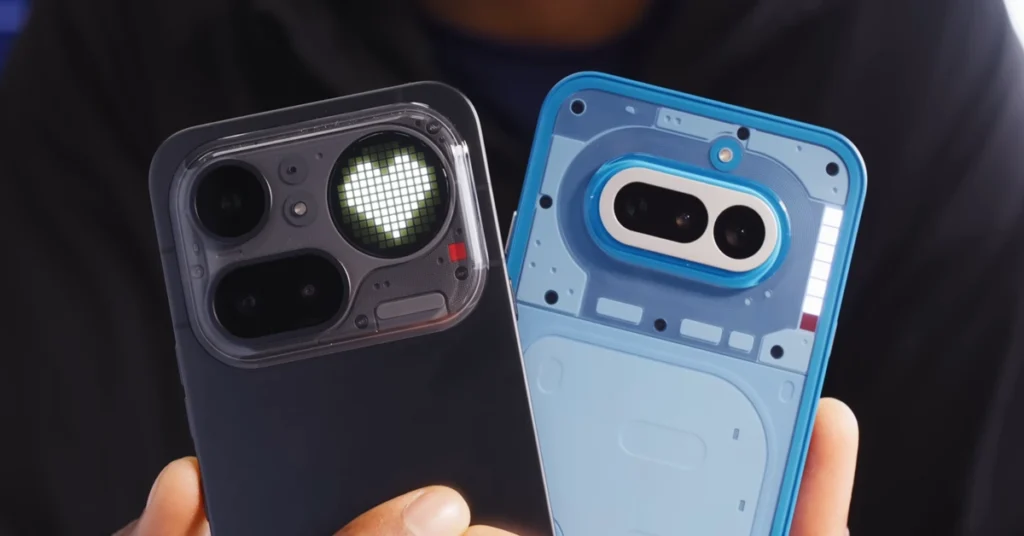
The Nothing Phone 4A in Blue is genuinely one of the most visually distinctive phones at this price point. Matte blue sides wrap around a semi-transparent rear panel that reveals the iconic Nothing dot matrix typography and underlying component geometry. The triple-camera module sits cleanly in the upper portion of the back. When you compare this to the iPhone 17e’s single lens or the Pixel 10A’s dual setup, the 4A’s visual sophistication immediately stands out.
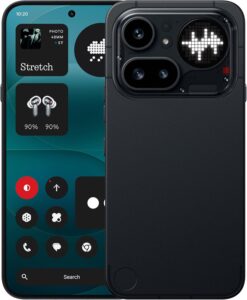
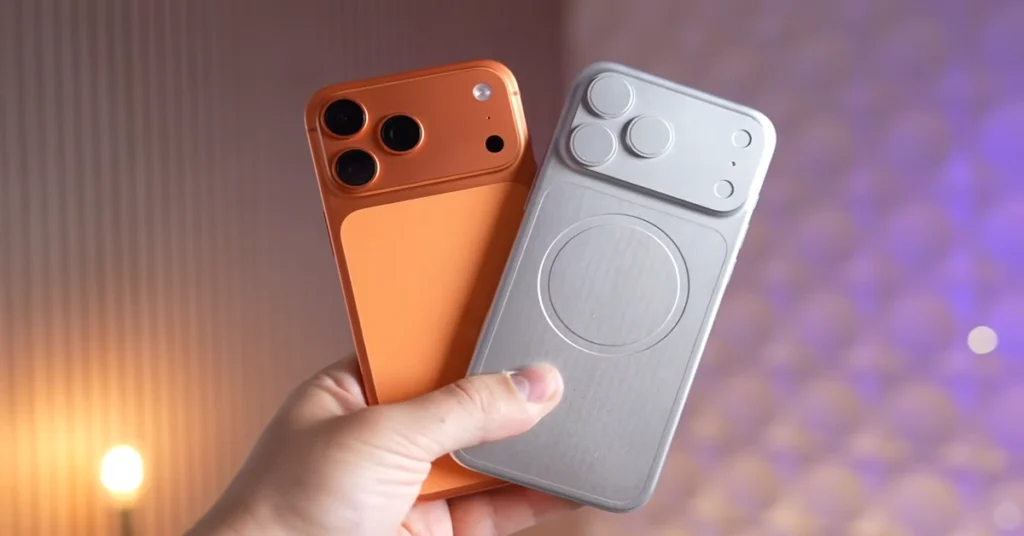
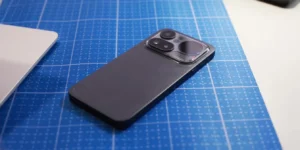
The Phone 4A Pro takes things further with a unibody aluminum chassis. You feel the difference the moment you pick it up — cold metal, rigid structure, and a camera plateau that deliberately channels flagship aesthetics without the flagship price tag. The tradeoff: the aluminum back is extraordinarily prone to fingerprint smudging and surprisingly resistant to cleaning. The clear cutout surrounding the cameras and the Glyph Matrix display is a striking visual detail that makes the Pro look genuinely premium.
Also Read – Apple MacBook Neo Review: Is the $599 MacBook the Most Disruptive Laptop Apple Has Ever Made?
One important note: neither phone includes wireless charging. The 4A Pro’s metal back has no charging coil cutout — a deliberate omission that will frustrate anyone in the wireless charging ecosystem.
Nothing OS 4.1 on Android 16: The Software Advantage That Gets Overlooked
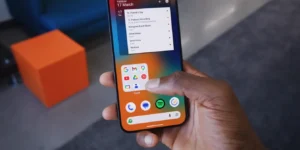
The Nothing software experience has quietly become one of the most refined mid-range Android implementations available. Nothing OS 4.1 running on Android 16 prioritizes smoothness and responsiveness — and it delivers. Even on the Snapdragon 7S Gen 4 inside the 4A, the interface feels fast, fluid, and never stuttery. A significant contributor to this is the updated storage: UFS 3.1 across both devices means faster app launches and snappier file operations compared to previous Nothing phones.
The home screen customization suite has expanded meaningfully. Folder behavior is now more flexible, and the Playground — Nothing’s community-driven widget store — opens up a genuinely interesting layer of personalization. Users have built everything from countdown timers showing remaining hours in the day, week, month, and year, to fully functional arcade games running inside a 1×1 widget tile. It is niche, it is enthusiast-facing, and it works.
One thing Nothing has always done well is creating an interface character that you notice when it is gone. Use a Nothing phone for a few weeks, then switch to stock Android or One UI, and you will find yourself missing specific home screen behaviors that simply do not exist elsewhere.
The Glyph Interface: One Bar vs Full Matrix — What Is Actually Useful?
The two phones take notably different approaches to the Glyph Interface. The Nothing Phone 4A features a vertical bar of seven LEDs on the right side of the rear panel, with the bottom LED permanently red. This bar handles volume indicators during music playback (when the phone is face down), progress bars for active navigation or calendar events, and countdown timers. The red LED blinks as a recording indicator during video capture — a feature that deserves to be on far more Android devices.
The Nothing Phone 4A Pro upgrades this to a full pixel-dot matrix display — a higher-resolution, brighter version of the matrix introduced on the Nothing Phone 3. This display is app-aware and contact-aware. You can assign specific icons to individual apps or contacts, so when you miss a Slack message, a Slack-specific icon illuminates the matrix. Miss a message from a specific contact, and a custom image — a heart, an initial, anything — appears instead. Custom images are also supported via photo import, though the ability to free-draw directly on the matrix would be a welcome future addition.
The practical philosophy behind Glyph is compelling: keep the phone face down, let the matrix tell you whether a notification is worth picking it up for. It reduces compulsive checking without creating a full screen-off interaction. Some of the animations — particularly the timer countdown on the Pro — are technically impressive but awkwardly disconnected from the built-in clock app, which limits their real-world utility.
Chipset Deep Dive: Snapdragon 7S Gen 4 vs Snapdragon 7 Gen 4
The chipset difference between the two phones is real but may be less impactful in practice than the spec sheet implies. The Snapdragon 7 Gen 4 in the Pro is a more capable chip with better sustained performance headroom. The Snapdragon 7S Gen 4 in the standard 4A is a cost-optimized variant with slightly lower peak throughput.
In everyday operation — browsing, social media, streaming, messaging, light gaming — the gap between these two chips is largely invisible. Nothing’s animation engine and UFS 3.1 storage do a significant amount of work to smooth over chip-level performance differences at the UI layer. You would need to run a sustained CPU benchmark or attempt a high-fidelity mobile game to reliably tell them apart. For most buyers in this price segment, the 7S Gen 4 in the 4A is more than sufficient.
What neither chip is: flagship territory. The Snapdragon 8 Elite Gen 5 is a different class of hardware entirely. Nothing’s decision not to pursue it is commercially rational and technically honest.
Camera System: Triple Lenses, Average Results
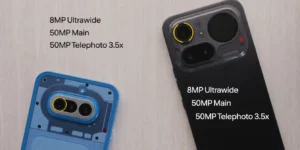
Both phones carry a triple-camera configuration — 50MP primary, 8MP ultrawide, and a 3.5x optical telephoto. The focal lengths are identical across both models. In this context, the camera system is a compelling spec-sheet feature, particularly against the iPhone 17e (single camera) and Pixel 10A (dual camera). In practice, the results land in firmly average territory.
Photos in good lighting are serviceable with reasonable dynamic range, but HDR processing can appear heavy-handed and noise levels at moderate ISO are higher than expected for a 2026 mid-range device. The telephoto captures usable shots at 3.5x, but the digital crop zoom modes — 70x on the 4A and 140x on the Pro — exist primarily as marketing numbers. 140x digital zoom on an 8MP ultrawide sensor delivers degraded, noisy output that you would never want to use in practice.
Neither phone can record 4K from the ultrawide camera. The 8MP sensor tops out at 1080p on that lens — 4K requires a minimum of 12 megapixels, and these sensors fall short. This is a genuine limitation for video creators who rely on the ultrawide for environmental or vlog-style footage.
Also Read – Apple MacBook Neo Review: Is the $599 MacBook the Most Disruptive Laptop Apple Has Ever Made?
The 144Hz Display Claim: What the Frame Rate Counter Actually Shows
The Nothing Phone 4A Pro is listed as supporting 144Hz refresh rate. This number appears in the spec sheet and even surfaces in the display settings menu. In real-world usage with a frame rate overlay active, the display consistently operates at 120Hz. The LTPS panel uses variable refresh rate from 30Hz to its maximum, but 144Hz activates only in a handful of supported games — similar to the behavior seen on certain Asus phones in previous years. For everyday scrolling, video playback, and app navigation, 144Hz may as well not exist. Do not factor it into your purchase decision.
AI Features: Intentionally Minimal — and That Is Arguably a Feature
Nothing has not loaded these phones with AI integrations. The Intelligence Toolkit is where all AI functionality lives, and it is deliberately sparse: an AI wallpaper generator and custom ChatGPT-powered widgets. There is no generative photo editing suite, no AI-driven call screening, no on-device large language model. The Essential Space — accessed via the physical shortcut button on the side — remains unchanged from previous generations.
For a segment of Android users exhausted by AI feature bloat across Samsung, Google, and Xiaomi flagships, this restraint is genuinely refreshing. Whether it remains a viable long-term product position depends on how central AI capabilities become to the Android mainstream experience over the next product cycle.
Nothing Phone 4A vs 4A Pro: Which One Should You Actually Buy?
The honest answer for most buyers is the Nothing Phone 4A. At €349, it delivers a distinctive design, smooth software performance, UFS 3.1 storage, triple cameras, a solid OLED display, and the Glyph LED bar — all in a package that comfortably outpaces what the Pixel 10A and iPhone 17e offer at similar or higher prices.
The Nothing Phone 4A Pro at $499 is not a bad phone. The unibody aluminum build is a tactile upgrade, the full Glyph Matrix is genuinely more useful than the LED bar, and the Snapdragon 7 Gen 4 offers a performance ceiling above the standard 4A. But the $150 premium for the US market buys you marginal real-world gains on most metrics. The 144Hz claim is misleading, the camera delta is negligible, the wireless charging omission stings at this price, and the fingerprint magnet aluminum back is a daily annoyance.
The Nothing Phone 4A is the stronger value proposition of the two. It is distinctive, fast, and well-priced. The 4A Pro is a refined step up with a better build and Glyph Matrix, but not a compelling $150 step up. If you are in the US and can only get the Pro — it is still a solid buy. If you have access to both, choose the 4A.
Value for Money: Price vs Overall Rating Chart
Price (USD) vs Overall Review Score — Mid-Range Phones 2026
Frequently Asked Questions (FAQ)
The 4A Pro uses a Snapdragon 7 Gen 4 chip (vs 7S Gen 4), a unibody aluminum build, a full pixel-dot Glyph Matrix display, IP65 water resistance, and a 144Hz display spec (though real-world refresh is 120Hz). The standard 4A costs significantly less and covers most of the same ground for everyday users.
Nothing publicly confirmed they would not release a flagship device in 2026. As a smaller manufacturer with lower supply chain volumes, building a competitive flagship with current-generation premium components — particularly high-capacity RAM — is both costly and commercially risky. The 4A and 4A Pro are strategic mid-range releases rather than a retreat from flagships.
Technically yes — in a small number of supported games. In all other use cases, the display operates at a maximum of 120Hz, even when peak refresh rate is forced in settings. For practical purposes, treat this as a 120Hz display.
No. Neither the 4A nor the 4A Pro supports wireless charging. The Pro’s metal unibody back does not include a charging coil cutout.
Both phones offer triple cameras (50MP main, 8MP ultrawide, 3.5x telephoto) but camera quality is average for the segment. Photos can appear over-processed with heavy HDR and above-average noise. Neither phone can record 4K from the ultrawide due to the 8MP sensor resolution ceiling.
The Glyph Interface is a rear LED system that displays notifications, timers, and indicators without requiring you to turn the phone over. The 4A uses a simple 7-LED bar. The 4A Pro features a full pixel-dot matrix that can display app icons, contact-specific images, and custom graphics. The practical value is in reducing screen-on time for routine notification checks.
The standard Nothing Phone 4A is not available in the US market. The Nothing Phone 4A Pro at $499 is the US-accessible option from this product line.
At similar price points, the Nothing Phone 4A offers a more distinctive design, triple cameras versus the Pixel 10A’s dual setup, and a more characterful software experience. The Pixel 10A has stronger camera processing and guaranteed Google software support longevity. For design-forward tech users who value aesthetics and UI personality, the 4A is the more compelling choice.